Fake University
210367
Tural Roorda
Assignment: Write for 15 minutes about the Oslo Opera house.
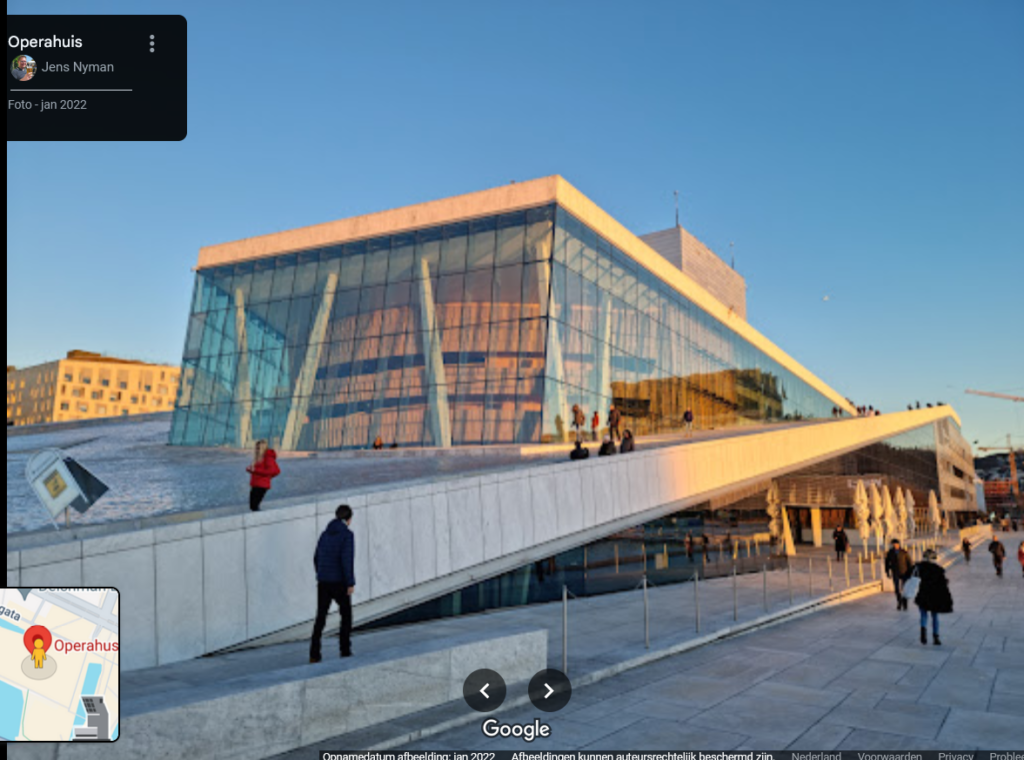
The Oslo opera house is a building constructed out of white stone, possibly marble, tastefully weaving a pattern between bigger & smaller chunks. It’s on the water, giving it a soundtrack of seagulls, running water & sea wind. My experience is primarily in its exterior, because I don’t think I can enter the inside. Truthfully, I haven’t checked because my intuition tells me it would be closed at 7am on a summer sunday. Its exterior is unique in that you can walk all over the building. It is constructed of slight inclines & semi-random raised sections to use as seats & steps. You can walk from the bottom to the roof of the building going no more than a 20 degree incline. The experience of arriving at the top felt wondrous that I could reach such height using only small, continuous raises in altitude. Walking does have a way of making time pass and you hardly notice it.
Regarding its safety, like what my brother Yesse said about the open high-intensity river running a few kilometres from the opera house, is refreshingly left to you, the visitor. It’s your choice to climb this slippery, large structure (“at your own risk”, a message plastered on every trashcan around). My brother attributes this to the, ironically, safer, more communal attitude in the architecture and its citizens. I imagine it works as a sign of trust and respect, like how any working relationship is. Now I’m sure injuries do happen, but if everyone is aware and the ‘intended path’ is safe from those risks, I see it as only more fun. More design than I can fathom probably happened behind the scenes to give me that impression and not feel like there’s a prominent deathtrap in the centre of a major city
Even on the ground level you get a fantastic view of the rest of the harbour. The ships, the rounds, the extended rails for shops (now docked), steps leading into the water, emergency ladder leading out of the water, industry, forested islands, construction work, tourists, runners, grass, boat homes, the Oslo library, the central station, hotels, factories, the blue sky, the soft wind the glass art piece moored off the coast like an expression of the ambition of the singers inside, and a look inside the house through the enormous windows.
The ~25 degree angle of most of the opera house succeeds in being easy to climb up while being annoying enough that you don’t want to stay up here long. Even though the building should offer plenty of shade, except when the sun faces directly in front of it, I felt in a rush to leave once I made it to the top. Despite how deliberate it is, I still get a feeling of wrongness being on the roof that I want to settle by going down. Maybe it was the lack of shade up there, maybe its that artificial height justin doing that, maybe being on the roof of my prestigious building gives the sense that i’m “approaching it wrong”. I should be inside, witnessing opera and being cultured, and instead i’m on the foundations, the incidental structure that houses that refined culture. The hard rock material, rather than the music, is immaterial & beautiful.
That is wrong, because the building’s architecture definitely counts to the culture. Even if it WASN’T publicly accessible to climb all over. This feeling of dual-purpose between climbable architecture and serious housing for culture is quite strong, now that I consider it.
If we are charitable, we can consider the architecture *in* on the joke, and making something fun for the public like wild fantasies of children building their ideal school, full of internal waterways and transport tubes and zero gravity classrooms.
We can also look at it as a cynical ploy to get engagement. But while that darkness exists here, so does it in everything. Everything is designed with people in mind… our attention/perception/experience is the point.
The question then is, how do you cleave a meaningful line between a cultural monument and a casino? Both seek your attention, both want to impart something on you. A good casino can even make the process of gambling an involved and engaging task. Actually, let’s forget casino’s and use Star Wars Battlefront 2 as an example.
Maybe the difference is the after-effect. You leave the monument satisfied, or at least done with that activity and it doesn’t ask more of you (except maybe sharing it with your loved ones, and having a stronger impression of the culture or country or area it was in). Star Wars BF2 leaves you with a progression system, an external incentive to go back to the game, promising every session to be better than the last. It uses that promise of increased power with items you can purchase with your real money, that just get you there faster, get that dopamine hit earlier.
I think I will leave the opera house satisfied, and I will probably never go inside. That’s ok, I don’t feel drawn to opera’s anyway.
For this certainty, agreement, and peace, I am grateful
Time taken: 40 minutes
Credits awarded: 15
Grade: B-
Teacher Comments: Gives genuine insight, but unstructured in second half and fails to tie it all together at the end very well. Exceeded time limit.